Category Archive: Check Valves
The Importance of Accurate Check Valve Sizing
Check valves are among a system’s essential components. For greatest efficiency and maximum protection, however, check valves must be properly sized in order to work at their highest level.
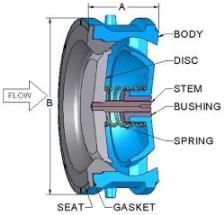
A properly sized check valve will make a system reliable and provide the longest service with the minimal amount of manual attention. Proper sizing will eliminate disc fluttering whether the valve’s disc is in the stable and fully open position against the internal stop, or in the fully closed position against the seat.
Properly sized check valves also contribute to overall cost savings. Appropriate sizing increases the lifespan of the valves, but also improves the longevity of pumps and other related components on the same system. Check valves that are sized correctly function well, and in the process enhance the safety of processes and applications.
Examples of Check Valves
There are a variety of types and styles of check valves. These are applied to a number of processes.
- Ball checks: Ball checks control the movement of flow by using a “ball” inside the body. The ball can freely rotate, resulting in a wearing and wiping action that is suited very well to handle viscous materials. Ball checks can also be spring-loaded to safely lock a system.
- Dual plate: Dual plate valves are made of two spring-loaded semicircular plates with a hinge in the center. These valves are known for their excellent flow capacity, due to their lightweight nature and compact face-to-face dimensions. Their compact size means they need less manual attention, support, and valuable real estate in a system.
- Piston Check: Piston check valves feature a body-guided or stem-guided disc that operates within the body bore. This ensures that the disc and seat are properly aligned when the valve closes. They are available in T pattern and Y pattern body designs. The latter usually have a higher flow coefficient than T pattern bodies.
- Swing Check and Tilting Disc: Swing check valves or tilting disc valves are designed with a hinged arm at the top of the valves. Gravity and reverse flow are the chief mechanisms responsible for closing this valve. These valves come with a variety of connections, such as socket weld, flanged, threaded, ring type joint or butt weld end connections.
- Spring Assisted In-Line/Axial Flow Check: These valves are also sometimes referred to as Nozzle Check or Silent Check Valves. Their primary design function is to prevent reverse flow and reduce or even eliminate water hammer. The mechanism behind this is a spring-assisted disc, constructed in line with the flow with a short travel distance, which acts as a fast-closing valve. These valves can be installed in any position, with either vertical or horizontal pipe runs, and is available with a number of different styles and end configurations.
Correct Sizing Means Best Fluid Handling
Before purchasing valves, be sure to consider a number of factors that go with it, chief among them proper sizing. Properly sized valves will prevent malfunctions and ensure that a system operates reliably and efficiently. All related system components will last longer and safety—both for the workers and the valves—will be enhanced.
Check valves play a central role in fluid handling systems, and it is crucial to ensure that they are properly sized. Consulting a qualified professional and carefully considering your options will help you choose the best check valve, and ultimately help your bottom line. The best valve choice gets you the most out of your systems and equipment for the longest possible and most efficient performance.

Design Elements to Consider when Selecting a Check Valve
Check valves perform a crucial function in pumping systems by permitting the forward flow of water when open, and preventing reverse flow when shut. When selecting a valve for your water and wastewater pumping system, you will likely want one that not only executes this task, but also does so efficiently.
Check valves should minimize energy consumption and also protect the system from pressure surges caused by water hammer. They should also suit your particular application. The two common types of check valves to examine are silent or in line check valves and swing check valves.
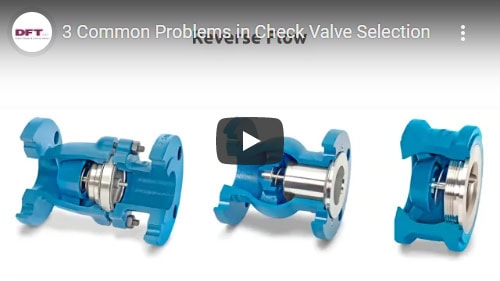
3 Common Problems in Check Valve Selection
Did you know that, unlike other types of valves, check valves continue to work if a plant loses electricity, air, manpower, or all of the above? They come in a wide variety of sizes, materials, and end connections, and can be used in countless applications.
So why is it that they’re often improperly sized or selected? It’s because check valves are only as good as their application. Oftentimes the problems with a check valve are not related to the valve itself, but application and other factors. So when you’re problem solving or replacing a check valve, keep these three common problems in mind:
Water Hammer
Water hammer is one of the most common check valve problems. Water hammer is a pressure surge that’s caused when a liquid or gas is forced to stop or change direction suddenly, and often occurs when a valve is suddenly closed at the end of a pipeline system. This can result in both noise and vibration, which can in turn lead to damage and additional maintenance or repair costs.
Water hammer can be prevented, however, by using a faster-closing check valve that stops the pressure surges and shock waves that can damage and rupture equipment. Our silent check valves in particular are known for their effectiveness in preventing and in many cases eliminating water hammer.
Reverse Flow
Reverse flow is another common check valve problem and can be extremely costly, especially when it occurs at the discharge of a pump, causing the pump to spin backwards.
DFT’s ALC and WLC Wafer Check Valves
Water hammer and reverse flow can be ongoing issues for large buildings and industrial piping. In the majority of cases, an unreliable double door or butterfly check valve was utilized and the results are these damaging issues. Double door or butterfly check valves often times incur failure of the door spring or hinge pin; leakage from misaligned doors and seats; reverse flow; and even internal parts flowing down stream.
The harming effects of water hammer include loud noise and rapid vibration to pipe collapse. Reverse flow can damage pumps and motors, a costly proposition to any company.
DFT Inc.’s Pulp and Paper Check Valves: Write On!
If you think of paper manufacturing (and its raw material, wood pulp), you probably think of trees, huge mills, and giant rollers. Water and liquid chemical delivery systems might not be the first things that come to mind. Both, however, comprise important steps in both pulp and paper production. Quick explanation: wood pulp is made up of certain fibers from wood, separated out from the main piece. This separation can be achieved through a number of different methods, one of which is through chemicals specially intended to break down the raw wood, while leaving the key cellulose fiber intact. As you might imagine, these chemicals can be fairly harsh, which is why DFT Inc.’s severe service check valves are the perfect replacement for standard swing check valves on batch digester systems.