When a check valve fails, the result can be unplanned downtime, equipment damage, safety hazards, and expensive repairs. That’s why rigorous quality assurance-supported by proper certifications and thorough testing-is essential long before a valve ever goes into service.
DFT® Inc. has been solving check valve problems and preventing failures in fluid systems across industries for over 80 years. Since the start, our mission has centered on engineering valves that go beyond basic line-size compatibility to deliver dependable performance, longer service life, and protection against issues like water hammer.
Certifications and testing are proof of that commitment. They validate not only how we manufacture our valves but also how we embed quality into engineering, production, and continuous improvement. Discover more about the Quality Management System, certifications, and testing standards we follow at DFT® to ensure consistent, high-performing valve solutions.
The DFT® Quality
Management System (QMS)
At DFT®, we are guided by a structured Quality Management System that establishes clear expectations, measurable goals, and accountability throughout the organization. DFT’s quality policy reflects this commitment:
“Our policy is to continuously improve customer satisfaction by supplying quality products when promised at a good value in compliance with the requirements of our Quality Management System.”
By aligning engineering, manufacturing, inspection, and documentation under a single system, our QMS helps ensure valves meet defined specifications and perform consistently in the field. This structure supports repeatability across production runs and reinforces accountability at every stage of the process.
With that in mind, the DFT® Quality Management System centers around four practical objectives that directly impact customer outcomes:
- Reduce customer complaints and scrap or rework.
- Improve on-time delivery performance and lead times.
- Successfully complete internal and external audits.
- Improve overall customer satisfaction.

Certifications and Compliance
DFT® certifications reflect that we have designed our valves to perform in, from global quality management systems to industry-specific regulatory and safety requirements.
Global Quality Management Standard: ISO 9001:2015
This certification establishes the foundation for how we manage, document, and improve quality across our operations.
ISO 9001:2015 is a globally recognized quality management standard focused on process control, risk-based thinking, and continual improvement. The certification confirms that quality processes are audited regularly and applied consistently across the organization.
For customers, this provides confidence that quality is built into daily operations rather than dependent on individual projects. It also supports predictable lead times and operational efficiency.
Specialty Certifications for Critical Industries
Some applications require additional verification because of elevated safety, regulatory, or operational risk.
Petroleum and Natural Gas: API 6D and API 6FA
These certifications confirm that DFT® valves meet established performance and safety standards for oil and gas pipeline and process systems.
The American Petroleum Institute (API) Monogram Program verifies compliance with industry requirements for petrochemical operations.
- API 6D applies to valves used in pipeline and piping systems for natural gas and petroleum service.
- API 6FA focuses on fire testing of check valves, verifying performance under fire-exposure conditions where safety is critical.
Hygienic and Sanitary Applications: 3-A Certificate
For food, beverage, and pharmaceutical environments, hygienic design standards are essential.
The 3-A Sanitary Standards certification addresses surface finish, cleanability, and fabrication practices. We provide valves that meet current hygienic design requirements, providing assurance for systems where contamination control is essential.

European Market Access: PED Module H
PED compliance ensures DFT® valves meet pressure equipment requirements for international use.
The Pressure Equipment Directive governs pressure equipment used in the European Union and related markets. DFT® supplies PED-compliant check valves to customers worldwide.
Compliance supports standardization for pressure equipment above 0.5 bar, including pipeline, safety, and relief valves, simplifying regulatory alignment for global projects.

Industry Standards and Best Practices: MSS Certificate
MSS standards provide a shared technical framework across the valve industry.
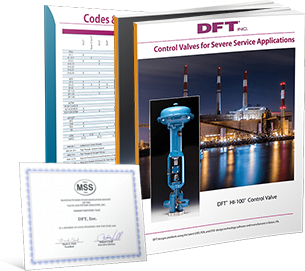
The Manufacturers Standardization Society develops engineering codes and standard practices for valves and fittings. DFT’s compliance confirms adherence to domestic and international standards developed by this key technical association.
DFT® Testing Protocols & Procedures
Testing confirms that each valve performs as intended under pressure before it reaches the customer.
Overview of Standards
100% of DFT® check valves undergo rigorous pressure and leak testing in accordance with recognized industry standards that define acceptance criteria for shell and seat testing. These procedures verify both structural integrity and sealing performance.

Shell Testing
Shell testing is performed in water at a gauge pressure that is at least 1.5 times the 100°F rating, rounded to the next highest 25 psi increment. This verifies the valve body’s ability to withstand pressure without leakage or deformation.
- Minimum test durations are as follows:
- Sizes 2″ and under: 15 seconds.
- Sizes 2½” to 6″: 60 seconds.
- Sizes 8″ to 12″: 120 seconds.
- Sizes 14″ and above: 300 seconds.
Seat Testing (Water)
Water seat testing confirms proper sealing performance under specified pressure conditions. The test is performed at a pressure at least 1.1 times the 100°F rating.
- Minimum test durations by valve size are as follows:
- Sizes 2″ and under: 15 seconds.
- Sizes 2½” to 8″: 30 seconds.
- Sizes 10″ to 18″: 60 seconds.
- Sizes 20″ and above: 120 seconds.
Soft seated valves must show no observable leakage. For metal seated valves, leakage can be no more than 40 ml/hr per inch of nominal valve size.

Seat Testing (Air)
Air testing applies to select valve models where air-based verification is required. Applicable models include SCV®, Basic-Check®, Vacuum Breaker, and Restrictor Check® valves:
- Test pressure is no less than 80 psig.
- Minimum duration is 15 seconds for sizes 2″ and under and 30 seconds for 3″ valves.
- Soft seated valves allow no observable leakage.
- Metal seated valves allow 0.4 SCFH per inch of inlet size.
A valve leak test infographic is available as a visual reference for these standards.

The DFT® Difference: Problem-Solving at the Core of Our Valve Design
Quality systems and testing establish consistency, while engineering ensures each valve is built to solve real system challenges. We have engineered DFT® valves to stop reverse flow, reduce water hammer, improve flow stability, and extend system lifespan. The development of the Basic-Check® valve and subsequent designs, such as ALC®, GLC®, and Excalibur®, reflects decades of listening to customer needs and delivering purpose-built inline check valve solutions.
DFT® partners with customers to deliver high-performance check and control valves that consistently meet or exceed quality, safety, and hygienic standards, as well as industry standards. Schedule a technical discovery call with a DFT® Valve Expert to learn more.