Category Archive: Webinar
Q&A from DFT’s Webinar: Check Valve Solutions for the Mining Industry
Following our webinar, Check Valve Solutions for the Mining Industry, we’re sharing some of the questions from the audience along with our detailed answers. In the webinar, presented by Arie Bregman—who brings nearly five decades of experience in the valve industry—we explored the role of check valves in dewatering, slurry transport, and preventing backflow. We covered best practices for sizing check valves correctly to ensure optimal performance in mining applications, strategies to prevent water hammer and mitigate pressure surges with non-slam check valves, and how proper valve selection can reduce maintenance while improving operational efficiency. Arie’s technical expertise and commitment to industry education make him the ideal guide for these critical topics. If you missed the webinar, you can now watch it on demand on the DFT® website—just [click here].
Q: Wont Gravity help close a swing check valve in a vertical flow up application?
A: Gravity will absolutely close a swing check valve, after the flow has already stopped. This will cause water hammer to occur every time. The Axial Flow design incorporates an internal spring that opposes the flow and will start closing the valve as the flow rate starts to drop due to pump shut down. If the valve has a cracking pressure of 0.39 psi (as I used in our sizing example), then when the flow rate results in a differential pressure through the valve of less that 0.39 psi the valve will be closed. Because flow hasn’t reversed you will avoid the hydraulic shock and resulting shock waves with the fluid inside the pipe.
Q: In a low flow application can you remove the spring in an axial flow check valve?
A: Yes you can remove the spring in an axial flow valve, but doing so will negate the benefit of water hammer reduction/elimination. You will also limit the installation orientation options when the spring is removed. The valve will continue to work because the reversing flow will now close the valve. This means that the valve will continue to function with a missing or broken spring, you just have to understand that the advantage of water hammer reduction/elimination of the axial flow design is now lost.
Q: How low of a cracking pressure spring can you specify?
A: Cracking pressure lower limits are a function of the size of the valve. Smaller valves have very light weight discs and so small screwed end valves from ½” up to 2” can tolerate a 0.1 psi spring while over coming any internal friction factors and still closing the disc against the seat. There are many steam condensate applications that need such a low cracking pressure, and those valves work very well in that environment. From about the 3” line size up to about an 8” line size the lower end of cracking pressures is about 0.25 psi. In all cases the factory should be consulted regarding lighter spring selection options. There is no one size fits all rule here, internal friction, disc/stem weight all play a role in determining the lower end of check valve cracking pressure.
Q: How does vertical flow down effect valve selection?
A: Vertical flow down is another unique application orientation that requires factory consultation. The weight of the disc/stem subassembly coupled with the spring selection all play a role coupled with any desired static fluid head that may need to be retained above the valve. The factory team understands these issues very well and are on hand to work with you to help you select the right valve for these applications.
Q: Is axial flow check valve suitable for slurry application
A: Yes, Axial Flow check valves can be used in slurry applications. The main concern with slurries would be the maximum particle size that would be contained within the slurry. Maximum particle size is always dependent on the nominal valve size and the amount of opening between the disc and seat that is available for the particles to pass through. Generally speaking, the amount of lift in an axial flow check valve is about 1/4 of the NPS, so a 4″ valve might have about 1″ of lift. The maximum particle size would be about 1/2 of that to allow it to pass easily through the valve.
Q: Are there any applications or process conditions where axial flow check valves are prone to damage, such as slugging?
A: High concentrations (above 25%) of large particles whose size exceeds 10% of the valve Nominal Pipe Size could be problematic for axial flow valve designs because of the potential for these particles to cause clogging of the valve. Lower concentrations of approximately 10% in a aqueous slurry should be able to flow through the valve with no major issues.
Q: In the case of higher solids content (20-30% by weight) do these valves perform well? The spring is not affected by the solid particles?
A: 20-30% solids whose maximum size is less than 5% of the valve NPS should not cause major problems. In all cases the spring is on the down stream side of the disc and is protected from direct impingement by solids in the media flowing through the valve. I wold urge you to discuss these applications with the factory to get their guidance early on in the specification process. All applications have unique parameters, and it is always difficult to give a one size fits all answer when it comes to solids in the flow stream.
Q: Would two valves back-to-back work? sometimes the process specifies two of them for safety
A: 2 valves back-to-back should work just fine. I would recommend that the 2 valves be spaced apart by at least 5 times the NPS to allow for the flow to restore to a more laminar flow as it enters the second valve. Excessively turbulent flow will cause unbalanced forces to act on the internal trim components of the second valve potentially leading to vibration related damages to occur.
Q: What’s the most challenging aspect of manufacturing these valves? How do you manage performance variability caused by assembly variation?
A: Axial flow check valves are relatively simple designs that are not too overly complex to manufacture. The manufacturing tolerances that impact the amount of opening of the valve and the space provided for the spring may have a very minor impact on the flow capacity (Cv) of the valve as well as a small impact on the cracking pressure of the valve. Generally, the Cv variability will be less than 1% of the stated value while the cracking pressure could vary by +/- 5% of the nominal published value.
Have questions about your mining applications? We’re here to help. Contact us today to discuss your needs. https://industrial.dft-valves.
Check Valve Solutions for the Mining Industry: Webinar Overview
 Mining is one of the oldest industries on Earth, but its challenges remain as modern as ever. At DFT®, we recently hosted a webinar titled Check Valve Solutions for the Mining Industry, led by Arie Bregman, who brings nearly five decades of experience in the valve industry. This session explored how the right check valve solutions help mines operate more safely, efficiently, and reliably—while avoiding costly problems like water hammer.
If you missed the original webinar launch, you can watch it on demand here. Below is an overview of what we covered.
Mining: A Global, Evolving Industry
Mining is a $3.5 trillion USD global industry that supplies essential raw materials for modern life—from precious and non-precious metals to lithium, coal, bitumen, salts, and gemstones. Extraction methods vary widely, from open-pit mining to deep underground mines, subsea mining, placer mining, and solution mining.
Each method has unique challenges, especially when it comes to water management, ore processing, and tailings disposal—all areas where reliable check valve solutions are critical.
Water Management: A Central Challenge
Both open-pit and underground mines must contend with significant water inflow—from groundwater, rain, or geological formations. Removing this water involves powerful pumps and extensive piping systems. A defining feature of these systems is vertical flow-up piping, where water must be lifted hundreds or thousands of feet to the surface.
Unlike horizontal systems, vertical pipelines require check valves that don’t rely on gravity to close. Without the right valve design, reverse flow during pump shutdown can create water hammer—a violent hydraulic shock that can damage equipment, increase maintenance costs, and pose serious safety risks.
Why Axial Flow (Silent) Check Valves?
DFT’s axial flow check valves (also known as silent check valves) are designed specifically to mitigate water hammer. Their spring-assisted closure ensures they react immediately to flow reversal, preventing pressure surges. They work in any orientation—horizontal or vertical—making them ideal for the unique vertical piping demands of mining.
Ore Processing and Refining Applications
Once ore is removed from the mine, it is crushed, concentrated, and refined. Processes like flotation, leaching, and electrowinning use chemicals and fluids to extract valuable minerals such as copper or gold.
These systems often feature vertical flow, corrosive solutions, and abrasive solids—all of which place demands on check valve performance:
- Materials: DFT valves are available in stainless steels (316 SS, 410 SS) and high alloys (Monel, Hastelloy, Titanium) to handle corrosive and abrasive media.
- Customization: Options for hardened trim (e.g., 410 SS, Stellite) increase resistance to erosion in slurry or acidic environments.
- Oxygen Service: Gold refining uses oxygen, which requires special materials, cleaning, and certification to ensure safety and purity.
Tailings Management
Tailings—slurries of rock fines and residual chemicals—are a by-product of ore processing. Moving these abrasive, high-volume flows requires large pumps and equally robust check valves.
DFT axial flow valves in wafer or flanged designs are widely used for these applications. Options include:
- Wafer Style: Compact and cost-effective, conforming to standards like API 594 and EN 558.
- Short Pattern Flanged: One-piece bodies for strength, with options in carbon steel and stainless steel.
- Custom Materials: Trim options such as 410 SS or higher alloys for erosive or corrosive service.
Special Considerations: Subsea and Solution Mining
Mining isn’t limited to land. Subsea mining brings its own challenges, including saltwater corrosion and high ambient pressure. Here, materials like Monel, Nickel Aluminum Bronze, and Titanium become important. DFT offers extensive experience supplying valves in these high-performance alloys.
In solution mining—where chemicals are injected into ore bodies to dissolve minerals in place—pumps and check valves must handle harsh fluids while preventing reverse flow and water hammer.
Sizing Your Check Valves Correctly
One of the most important takeaways from our webinar is proper sizing. It’s not enough to match valve size to pipe diameter. Flow rates, pressure drop, and cracking pressure all matter. Undersized or oversized valves can:
- Fail to open fully at low flow, leading to chatter and premature wear.
- Create excessive pressure drop or noise at high flow.
DFT provides Cv values and detailed sizing guidance to ensure the valve works optimally in its specific application—reducing maintenance costs and improving reliability.
Why Choose DFT® Check Valves?
DFT® offers a wide range of axial flow check valves, engineered for the demands of mining:
- Axial flow design that eliminates water hammer
- Sizes from ½” through 42″
- Wafer and flanged styles, with end connections meeting ASME, EN, and API standards
- Materials from carbon steel to stainless steel, Monel, Inconel, Hastelloy, and Titanium
- Custom sizing support to optimize performance in your unique application
- Full QA documentation and certifications for specialized service
Watch the Webinar On Demand
If you missed Check Valve Solutions for the Mining Industry or want to review the details, you can watch it on demand here.
Have questions about your mining applications? We’re here to help. Contact us today to discuss your needs.
Webinar Q and A: Check Valve Applications for LNG Service
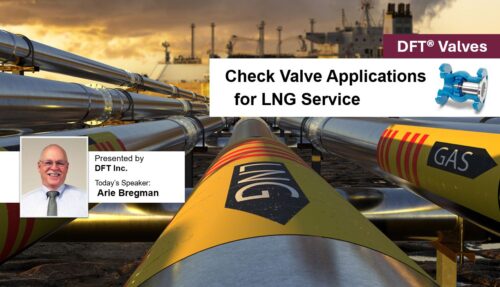 Following our webinar, “Check Valve Applications for LNG Service,” we’re sharing some of the questions from the audience along with our answers.
In the webinar, we covered the fundamentals of LNG processes and the specific check valves used in liquefaction, storage, and transportation. We also discussed optimal valve placement and the importance of proper valve sizing to ensure efficiency and reliability.
The webinar was presented by Arie Bregman, who brings nearly five decades of experience in the valve industry. His technical expertise and commitment to industry education make him the ideal guide for navigating check valve applications in LNG service.
If you missed the live event, you can now watch it on demand on the DFT® website—just click here.
Q: What problems will I have if I have a swing check in a vertical pipeline?
A: The main problems you will experience will either be the valve is stuck open and will not close, or there is a loud slamming sound that rattles the piping every time the pump shuts down. The DFT Axial flow check valve will solve these problems. Again, make sure you know the flow conditions and have the valve sized to insure you have a properly specified valve going in.
Q: What other options are there besides changing the spring when I am sizing a DFT Check Valve?
A: Besides changing the spring, DFT also can provide a travel stop to limit the amount of opening of the valve. Another option could be a reduced trim size internal to the valve or a nozzle style seat to increase the inlet pressure at the valve. These all have tradeoffs that you will need to discuss with your local DFT salesperson.
Q: What problems will I experience with an oversized check valve?
A: An oversized check valve will experience chatter. Perhaps you have heard the tap, tap, tapping of some installed swing checks? This is indicative of a low flow situation. Eventually this valve will experience excessive wear and will require a full overhaul or replacement. Make sure you size the new valve you put in or you will be doing this again real soon.
Q: I have a swing check installed but now want to change to a DFT Axial Flow check, does that require piping changes?
A: DFT manufactures valves to specific face to face standards. DFT has a valve that will replace any swing check or double door check valve with a direct swap out replacement. No piping modifications will be required.
Q: May swing check valve be used in LNG?
A: Yes, swing checks can be used in LNG applications, but sizing is critical. Swing check valves require a minimum flow rate of 8 feet per second (2.5 meters per second) in order for them to be fully open and stable. If your application does not achieve this flow rate through the valve you will experience chatter and eventually this valve will fail. DFT’s axial flow check can be custom sized by modifying the spring or installing a travel stop to put the disc in a non-chattering condition for low flow applications.
Q: How close can you put a check valve to a Knife gate valve, 8″ Ambient water
A: Physically you can mount a check valve directly to the knife gate valve, but the flow entering the check valve will be turbulent. This could make the internals of the check valve unstable (chattering) which will lead to premature wear and failure of the check valve. It is always recommended that at least 5X NPS of straight piping be placed between the knife gate and the check to allow the turbulent flow to return to laminar flow before entering the check valve.
Q: How can JT effects be minimized in check valves for LNG Service?
A: The sizing and configuration program that DFT has will provide you with velocities and pressure losses within the valve. By properly sizing the valve for minimum velocities JT effects can also be minimized.
Q: Our company prefers lug style DFT valves over wafer style. What are the advantages and disadvantages?
A: The advantages for a lugged style body can include, ease of installation, higher level of flange gasket and seal integrity in stable thermal environments as well as extreme temperature situations like an external fire, or even high temperature swings within the media itself. The only disadvantage is the added cost. I feel that this small cost premium for a lugged style body is often outweighed by these advantages.
Q: When sizing for downward flow, do you have to account to total head pressure?
A: Yes, total head pressure must always be considered.
Q: Can we get access to the DFT Sizing Programs?
A: Contact your DFT sales representative and they can work with you to provide sizing services based on your specifications.
Q: What information is needed to get a correct quotation?
A: All the flow information will be required for media, pressure, temperature, pressure, flow rate under minimum, maximum and normal operating conditions for each valve throughout the system.
For more than 80 years, DFT® Inc. has helped customers find and install the right check valves for their unique applications. To learn more about our valves and how we can assist you, contact us or find a DFT Sales Manager in your area.
Join Us for an Exclusive Webinar on Check Valve Applications for LNG Service
Title: Check Valve Applications for LNG Service
Presented by: DFT Inc.
Hosted by: GlobalSpec
Date: September 18, 2024
Time: 10:00 AM EDT (7:00 AM PDT / 4:00 PM CEST)
As the demand for Liquid Natural Gas (LNG) continues to rise, understanding the infrastructure behind this vital energy resource is critical for engineers and industry professionals. LNG is a key player in today’s energy markets, known for its efficiency in storage and transport, making it an attractive option for power generation, industrial use, and transportation.
LNG’s operating conditions — including cryogenic temperatures, high pressures, and flow dynamics — place specific requirements on the equipment used in its processing systems. That’s why selecting the right check valve is paramount for ensuring system reliability and avoiding costly disruptions.
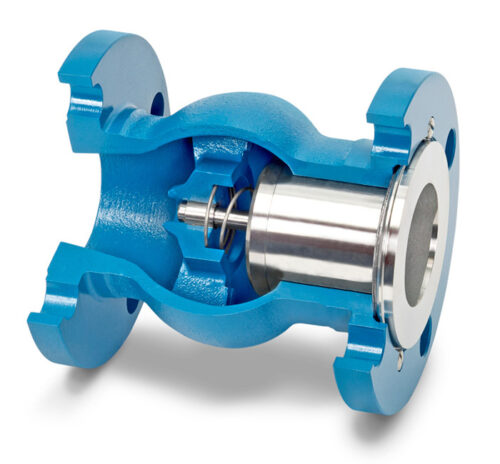
This webinar, presented by DFT and hosted by GlobalSpec, will provide valuable insights into the application of spring-assisted non-slam check valves within LNG service. The session will feature Arie Bregman, a seasoned valve industry expert with decades of experience in valve engineering, as he explores how check valves function within LNG processes and why their proper installation and sizing is critical for efficient system performance.
Why Should You Attend?
The webinar is geared toward valve professionals, engineers, and plant managers who are involved in LNG systems and valve selection. Attendees will gain practical insights that can be directly applied to improving operational reliability and efficiency.
Key Topics to be Covered:
- Understanding LNG Fundamentals: A brief introduction to the basics of LNG, its properties, including the processes and equipment used in liquefaction, storage, and transportation.
- Check Valve Applications in LNG: Gain insights into where and how check valves are used within LNG systems, focusing on key applications that optimize system efficiency and prevent flow disruptions.
- Optimal Valve Placement: Learn how strategic valve placement within LNG systems can significantly reduce wear, tear, and potential failures.
- Importance of Valve Sizing: Sizing check valves correctly can prevent common operational issues such as chattering and improper flow control. We’ll guide you through the critical considerations in valve sizing to ensure valves perform optimally.
- Industry Standards & Compliance: Familiarize yourself with the latest industry standards and specifications, ensuring your projects meet regulatory requirements and adhere to best practices.
Meet the Expert: Arie Bregman
Our speaker, Arie Bregman, brings nearly five decades of experience in the valve industry. From his beginnings with Nibco to significant roles at Jamesbury, Metso/Valmet, and DFT, Bregman has established himself as a respected voice in valve engineering. He holds a Master’s Degree in Mechanical Engineering from Worcester Polytechnic Institute and has served in leadership roles within the Valve Manufacturers Association of North America. His technical expertise and commitment to industry education make him the perfect guide to walk you through check valve applications in LNG service. DFT is pleased to welcome him back to present this special webinar on Check Valve Applications for LNG Service!
Don’t Miss Out!
Whether you’re a seasoned professional optimizing your current systems, or a valve professional seeking to deepen their understanding of valve applications within LNG processes, this webinar will provide insights about proper selection and application of check valves within LNG services. By attending, you’ll walk away with actionable knowledge to improve the efficiency and reliability of your operations.
Register now to secure your spot in this must-attend webinar on September 18, 2024.
Can’t make the date? Register and you will be notified when the webinar is available to watch on-demand.