DFT Webinar Q&A: Pulsating Flow & Check Valves: Solving Reciprocating Compressor Discharge Problems
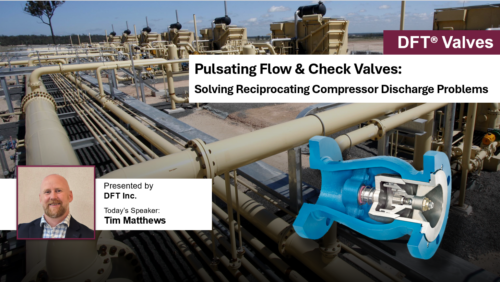
Thank you to everyone who joined our recent webinar, Pulsating Flow & Check Valves: Solving Reciprocating Compressor Discharge Problems. Attendees brought thoughtful, practical questions about how pulsating flow affects check valve performance, and how to choose the right valve for reciprocating compressor service. Below, we’ve gathered the questions we received, along with our answers, covering PDC® valve applications, installation, chatter and more. If you missed the webinar, it is now available on-demand.
If you missed the webinar, you can now view it on demand. Simply click this link.
Q: Is the PDC valve limited to gas applications, or can it also be used with air and vapor? Does gas condensate affect how the PDC operates?
A: The PDC can be used with air, vapor and gas, but not with liquids. Gas condensate can affect operation: if condensation forms in the dampening chamber, it can impede the valve’s function, so we do not recommend the PDC for condensate applications. Note that “dry” natural gas still contains some moisture in the line, but this does not affect the valve’s functionality.
Q: What is the effective flow area (or effective ‘beta’ value) of the PDC when it’s fully open?
A: DFT does not publish flow values, such as effective flow area or an effective “beta” value, for the PDC. For help with sizing or flow calculations for your application, please contact DFT with your operating conditions.
Q: Can the PDC model also be applied to reciprocating pumps handling liquids?
A: No. The PDC is designed specifically for air and gas applications, so it is not suitable for reciprocating pumps handling liquids.
Q: Does a PDC eliminate pulsation from the piping system?
A: No. The PDC should not be confused with a system pulsation dampener.
Its pulse-dampening feature is intended to control the response of the check valve disc to momentary flow reductions.
If the overall piping system has a significant pulsation problem, additional analysis or pulsation-control equipment may still be required.
Q: Is every reciprocating compressor application automatically a PDC application?
A: Not automatically.
The compressor type is an important clue, but we still want to review the actual operating conditions, flow range, pressure, temperature and installation details.
The goal is always to make an application-specific recommendation.
Q: Can an oversized check valve contribute to chatter?
A: Absolutely.
A check valve requires sufficient flow force to reach and maintain a stable operating position.
If the valve is oversized relative to the actual flow, the disc may operate partially open and can become unstable.
That is why sizing based on actual operating conditions is so important.
Q: Can the PDC be installed vertically?
A: The specific valve configuration and application should always be reviewed, but PDC installations can accommodate horizontal or vertical configurations depending on the application.
Q: How do I know whether the check valve is actually chattering?
A: Sometimes it is obvious because you can hear it.
Other times, the evidence comes from recurring internal wear.
If the same valve position repeatedly experiences seat, guide or spring damage, that should trigger an evaluation of valve dynamics.
Q: What’s the most important information to send DFT?
A: Flow conditions are extremely important.
Normal flow, minimum flow and maximum flow give us much more information than simply the pipe diameter.
We also want the pressure, temperature, media, valve size, compressor information and details regarding any existing problem.
Q: What’s the difference between pulse dampening and a stronger spring?
A: A stronger spring changes the closing force acting on the disc.
Pulse dampening is intended to control the disc’s response to short-duration flow changes.
Simply increasing spring force isn’t automatically the solution because that also changes the flow required to open and maintain the valve in its operating position.
The entire application needs to be considered.
Q: Would a PDC solve water hammer?
A: It depends on what is causing the transient.
The PDC is specifically focused on pulsating-flow applications such as reciprocating compressor discharge.
If the issue is traditional check valve slam associated with pump shutdown and reverse velocity, another spring-assisted axial-flow check valve may be the appropriate solution.